Case study
How two words changed everything: the InnerEye story
 Elizabeth SlavinAugust 20, 2022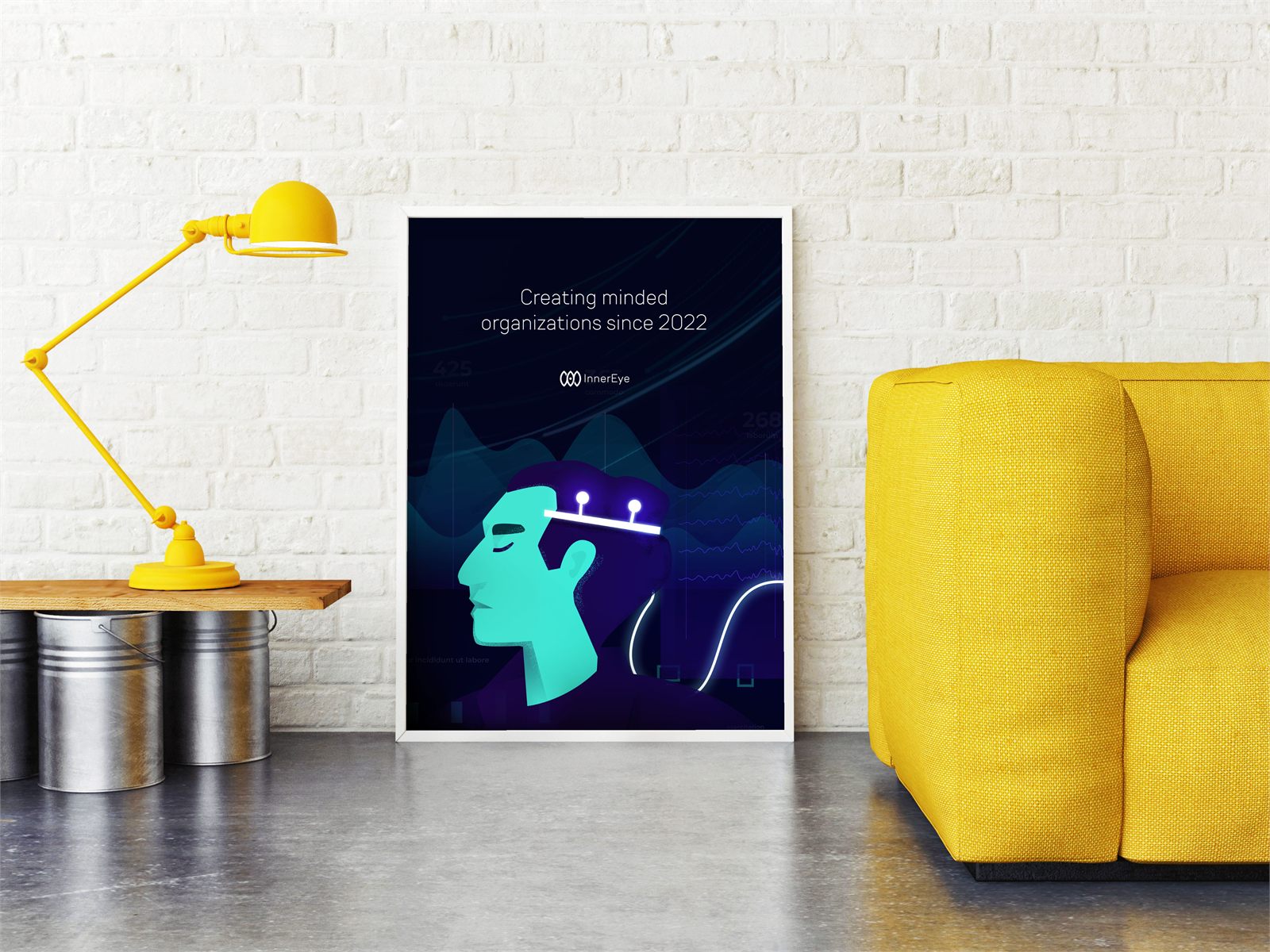
Some brand stories take months to find. Occasionally, if the work is going well and the right people are in the room, they arrive in an afternoon. The InnerEye story arrived in two words.
Minded AI.
The challenge of explaining the unexplainable
InnerEye was born in the labs of Hebrew University and Ben-Gurion University, where two neuroscientists, Professor Leon Deouell and Professor Amir Geva, were working on something that had never been done before. They were training AI not on data sets or labeled images, but on the brain activity of human experts.
Think about what that means for a moment. The accumulated knowledge of a trained military analyst, the pattern recognition of an experienced quality control engineer, the diagnostic instinct of a seasoned clinician: all of it captured, not through interviews or documentation, but by scanning the expert's brain as they worked. Then transferred, at scale, into an AI system that could replicate that expertise instantly and indefinitely.
The technology was extraordinary. The challenge was explaining it in a way that didn't require a neuroscience degree to understand.
Finding the story in the science
This is the moment that brand strategy either earns its keep or fails completely. The temptation with deep tech is always to explain the mechanism: how it works, what makes it different at a technical level, why the science is sound. And InnerEye had a very good mechanism to explain.
But mechanisms don't move markets. Stories do.
The question we kept coming back to was simpler than the technology: what is this, really? Strip away the neuroscience, the BCI terminology, the patent descriptions. What has InnerEye actually built?
The answer was sitting in the science the whole time. They had found a way to give AI a mind. Not data. Not algorithms. The actual cognitive patterns of human expertise, transferred directly from the brain of the person who spent a career developing them.
That's not machine learning. That's something fundamentally different. That's Minded AI.
Minded AI is one of those rare brand moments where the name and the positioning are the same thing. It doesn't describe the product. It defines the category.
Two words that do the work of a thousand
Minded AI is one of those rare brand moments where the name and the positioning are the same thing. It doesn't describe the product. It defines the category.
It tells you immediately that this AI is different from every other AI. It has something others don't: the mind of an expert behind it. Not simulated expertise. Not trained inference. Actual human cognitive expertise, captured and scaled.
For defense and homeland security customers evaluating target detection systems, Minded AI communicates an edge that no spec sheet can. For industrial manufacturers dealing with micro-defect detection in automotive assembly, it signals a level of precision that comes from somewhere deeper than data. For healthcare applications where the stakes of getting it wrong are measured in human lives, it promises something that AI alone has never been able to promise: genuine human judgment, at machine speed.
Two words. Every market. One story.
Why this kind of clarity matters
InnerEye's journey from academic spin-off to a company with international patents, distribution agreements across markets, and recognition from Frost & Sullivan and the US Department of Defense is remarkable. But what makes it instructive as a brand story is something simpler.
The technology was always exceptional. The science was always sound. The applications were always real. What changed when the story clicked into place was the ability to communicate all of that, instantly, to anyone in any market, without losing the depth of what the company had actually built.
Minded AI doesn't dumb it down. It opens a door. Behind that door, for the customer who walks through it, is everything InnerEye has spent over a decade building. The neuroscience. The patents. The proof of concept installations. The defense applications and the industrial ones and the healthcare ones. All of it becomes accessible the moment the story is clear.
That's what two words can do when they're the right two words.
The lesson for deep tech brands
If you're building something genuinely new, something that doesn't fit neatly into an existing category, the instinct is to explain it thoroughly. To give people all the information they need to understand why it's different.
That instinct is almost always wrong.
What people need first isn't information. It's a story they can hold onto. Something clear enough to repeat, compelling enough to remember, and true enough to survive contact with the science.
Find those two words. Everything else will follow.